Best Portable EV Chargers - On-the-Go
A portable Level 2 charger lives in your trunk or frunk and turns almost any 240V outlet — a dryer plug, an RV pedestal, a friend's garage — into a fast charge. It's the difference between adding ~4 miles of range per hour on a standard wall outlet and 25–30 miles per hour wherever you land. For apartment dwellers, road-trippers, and anyone who doesn't want to hardwire a wall unit, a good portable EVSE is the most flexible charger you can own. Here are four sold on Amazon right now, from Tesla's own connector to rugged 40-amp cables. The short answer: buy a 40A unit with adjustable amperage and a NEMA 14-50 plug if your car's onboard AC charger is 11 kW or more, and a 32A unit if it isn't — a 40A cable cannot push more power than the car will accept, and overpaying for amps you can't use is the most common mistake here. On 240V at 40A expect roughly 26–35 miles of range per hour depending on your car's efficiency; on a normal 120V household outlet, about 4–5. Both figures, and the onboard-charger limits for common EVs, are in the tables further down.
Portable charger picks at a glance
| Pick | Max power | Connector | Cable | Plug | Street price |
|---|---|---|---|---|---|
| Lectron 240V 40A Portable Level 2 Best Overall | Up to 40A, 9.6 kW | J1772 | 21 ft | NEMA 14-50 | ~$240 |
| Tesla Mobile Connector (Gen 2) Best for Tesla | Up to 32A, 7.7 kW | NACS (Tesla) | 20 ft | NEMA 14-50 + 5-15 (120V) adapters | ~$250 |
| Grizzl-E Mini Connect Most Durable | Up to 40A, 9.6 kW | NACS or J1772 | 25 ft | NEMA 14-50 | ~$390 |
| EVDANCE Portable Level 1 & 2 EV Charger Best Value | Up to 32A, 7.7 kW | J1772 | 25 ft | NEMA 14-50 (+ 5-15 adapter) | ~$110 |
What to look for in a portable charger
- Charging speed in amps and the real-world miles of range added per hour
- Connector type and compatibility (J1772, NACS/Tesla, or CCS)
- Cable length and a weatherproof rating if it lives outdoors
- UL or ETL safety certification — non-negotiable for anything wired to your home
- Smart features: scheduling for off-peak rates, app monitoring, and load management
Our top portable charger picks for 2026
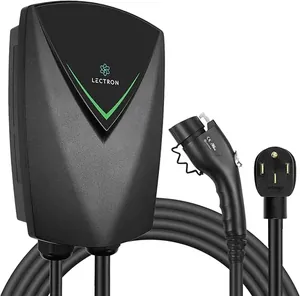
Lectron 240V 40A Portable Level 2 — Best Overall
- Max power: Up to 40A, 9.6 kW
- Connector: J1772
- Cable: 21 ft
- Plug: NEMA 14-50
- Adjustable: Yes (lower current for weak circuits)
- Street price: ~$240
The Lectron portable is the sweet spot: a no-frills 40A Level 2 cable that plugs into any NEMA 14-50 outlet and adds roughly 30 miles of range per hour — the same speed as many wall units, with zero installation. It's built for the trunk: coil it up, drop it in, and you've got fast charging at campgrounds, rental houses, or a relative's dryer outlet. J1772 works with every non-Tesla EV (and Teslas via the adapter that ships with the car). At around $240 it costs less than half of many wall boxes.
Best for: Renters, road-trippers, and anyone who wants wall-unit speed without installation.
Pros:
- ✓ 40A / ~30 miles of range per hour
- ✓ Plugs into common NEMA 14-50 outlets
- ✓ Genuinely trunk-portable
- ✓ Strong value versus wall units
Cons:
- ✗ No app or built-in scheduling
- ✗ Needs an existing 240V outlet
- ✗ More handling than a fixed wall unit
Tesla Mobile Connector (Gen 2) — Best for Tesla
- Max power: Up to 32A, 7.7 kW
- Connector: NACS (Tesla)
- Cable: 20 ft
- Plug: NEMA 14-50 + 5-15 (120V) adapters
- Adjustable: Auto by adapter
- Street price: ~$250
Tesla's own Mobile Connector is the natural travel charger for any Tesla: native NACS, and it ships with both a 120V (NEMA 5-15) adapter for emergencies and a 240V NEMA 14-50 adapter for real Level 2 speed. On 240V it pulls up to 32A for ~30 miles of range per hour; on a regular wall outlet it trickle-charges anywhere. It's compact, Tesla-reliable, and stores neatly in the frunk. Non-Tesla owners should skip this in favor of a J1772 portable.
Best for: Tesla owners who want a compact, brand-native travel charger with 120V backup.
Pros:
- ✓ Native NACS, plug-and-play for Tesla
- ✓ Includes both 120V and 240V adapters
- ✓ Compact and Tesla-reliable
- ✓ Large ecosystem of extra outlet adapters
Cons:
- ✗ 32A max (slower than 40A units)
- ✗ NACS-only — not for J1772 EVs
- ✗ Extra outlet adapters sold separately
Grizzl-E Mini Connect — Most Durable
- Max power: Up to 40A, 9.6 kW
- Connector: NACS or J1772
- Cable: 25 ft
- Plug: NEMA 14-50
- Adjustable: Yes
- Street price: ~$390
The Grizzl-E Mini brings the brand's tank-like reputation to a portable unit: a rugged, UL-certified 40A EVSE with a long 25-foot cable and Grizzl-E's all-weather build. It's the portable to buy if it will live outdoors, get tossed in a truck bed, or face hard winters. Adjustable amperage lets you dial it down for weaker circuits, and it comes in NACS or J1772 to match your car. Pricier than a bare Lectron cable, but far tougher.
Best for: Owners who want a portable that survives outdoor abuse and cold climates.
Pros:
- ✓ UL certified, rugged all-weather build
- ✓ Long 25 ft cable
- ✓ 40A with adjustable output
- ✓ NACS or J1772 versions
Cons:
- ✗ Pricier than basic portables
- ✗ Heavier to coil and carry
- ✗ Still needs a 240V outlet
EVDANCE Portable Level 1 & 2 EV Charger — Best Value
- Max power: Up to 32A, 7.7 kW
- Connector: J1772
- Cable: 25 ft
- Plug: NEMA 14-50 (+ 5-15 adapter)
- Adjustable: Yes (amperage + timer)
- Street price: ~$110
EVDANCE has become one of Amazon's best-selling portable chargers, and it's the value standout: a Level 1 and Level 2 unit that plugs into a NEMA 14-50 for up to 32A (about 25 miles of range per hour) or a standard outlet in a pinch, with a long 25-foot cable, adjustable amperage, and a charge timer. It's ETL-listed and well reviewed, at a fraction of a wall unit's price. A superb first portable or trunk backup.
Best for: Budget buyers who want a top-rated, do-everything portable with a long cable.
Pros:
- ✓ Level 1 + Level 2 in one, 25 ft cable
- ✓ Adjustable amperage and a built-in timer
- ✓ ETL-listed and highly rated
- ✓ One of Amazon's best-selling portables
Cons:
- ✗ 32A max (fine for overnight)
- ✗ No app/smart scheduling
- ✗ Needs a 240V outlet for Level 2 speed
Start here: the cap is usually your car, not the cable
The single most common way to waste money on a portable charger is buying more amps than your car can take. A 40A cable plugged into a car with a 7.7 kW onboard charger delivers 7.7 kW — the extra capacity does nothing. AC charging speed is limited by whichever is smallest: the circuit, the cable, or the car's onboard AC charger. It is almost always the car.
| Vehicle | Onboard AC charger | Portable amperage worth buying |
|---|---|---|
| Tesla Model 3 / Model Y (Long Range, Performance) | 11.5 kW (48A) | 40A — the practical ceiling on a plug-in portable |
| Tesla Model Y RWD / standard range | 7.7 kW (32A) | 32A is enough — a 40A unit adds nothing |
| Hyundai Ioniq 5 / Kia EV6 | ~10.9–11 kW | 40A |
| Ford Mustang Mach-E (2026) | 11 kW standard | 40A |
| Chevy Bolt EV | 7.7 kW on earlier cars; up to ~11 kW on 2022–2023 | 32A for an early Bolt, 40A for a late one |
| Ford F-150 Lightning | 11.3 kW; 19.2 kW only with the dual onboard chargers and Charge Station Pro | 40A (19.2 kW needs a hardwired unit, not a portable) |
Two things follow from that table. First, if you drive a base Model Y, buy the 32A unit and spend the difference elsewhere. Second, nothing portable reaches 48 A — plug-in cords top out around 40 A because NEMA 14-50 outlets sit on 50 A circuits and code limits a continuous load to 80% of the circuit. If you want 11.5 kW at home you need a hardwired wall unit, which is a different product and a different guide: see our home charger guide.
Check your own car's figure in the owner's manual under AC or Level 2 charging before you buy — trims differ within the same model, as the two Model Y rows show.
What each amperage actually adds per hour
Charging power is simply volts × amps. Turning that into miles depends on your car's efficiency, so the table below gives the power exactly and then the range at three efficiency levels: 3.0 mi/kWh (a big electric truck or large SUV), 3.5 mi/kWh (a typical mid-size EV) and 4.0 mi/kWh (an efficient sedan). All figures allow roughly 10% for AC-to-battery conversion loss, which is why they come in slightly below raw arithmetic.
| Outlet and setting | Power | Miles added per hour (3.0 / 3.5 / 4.0 mi/kWh) |
|---|---|---|
| 120V household, 12A (NEMA 5-15) | 1.44 kW | ~4 / 4.5 / 5 |
| 240V, 16A | 3.84 kW | ~10 / 12 / 14 |
| 240V, 24A | 5.76 kW | ~15 / 18 / 21 |
| 240V, 32A | 7.68 kW | ~21 / 24 / 28 |
| 240V, 40A (NEMA 14-50) | 9.6 kW | ~26 / 30 / 35 |
The 120V row is the one worth staring at. A standard wall outlet adds roughly 4–5 miles an hour, so an eight-hour overnight gets you about 35–40 miles. That is genuinely enough if you commute 30 miles a day and nothing else — and hopeless if you drive 80. Moving the same car to a 240V outlet at 32A takes the same overnight from ~40 miles to ~200.
Why dialling amperage down is a feature, not a compromise. Every adjustable unit in the picks above lets you reduce current. On an older 240V circuit, an unknown outlet at a rental, or a long extension run, dropping from 40A to 24A trades about 12 miles per hour for a much lower chance of tripping a breaker or heating up a marginal outlet. Charging slower overnight costs you nothing if the car is sitting there for ten hours anyway.
Portable vs. permanent: which do you need?
A portable EVSE makes sense if you rent, move often, road-trip, or simply don't want to pay an electrician to hardwire a wall box. Plugged into a NEMA 14-50, a 40A portable charges just as fast as most wall units — the only trade-off is that you handle the cable instead of leaving it mounted. Choose a permanent wall charger instead if you want a fixed, always-there station with app scheduling and energy tracking, or if you need the full 48–50A that only hardwiring unlocks.
Outlets you can actually use
The gold standard is a NEMA 14-50 (the 240V range/RV outlet) — that's where these portables hit 40A. A NEMA 6-50 welder outlet works too. Older 10-30 / 14-30 dryer outlets deliver less (usually ~24A) with the right adapter. In a pinch, a standard 120V (5-15) outlet gives only Level 1 trickle charging (~3–4 miles per hour). Remember the 80% rule: a charger draws up to 80% of the circuit rating, so a 40A charger needs a 50A circuit.
Which connector and adapters your car actually needs
This trips up more buyers than anything else, largely because three plug standards get discussed as if they were interchangeable. For portable Level 2 charging only two matter:
- J1772 — the AC charging plug on every non-Tesla EV sold in North America.
- NACS — Tesla's plug, which carries both AC and DC.
- CCS1 is not relevant here. It is the DC fast-charging plug. No portable Level 2 unit uses CCS, so if a listing mentions CCS, it is either confused or not a Level 2 cord.
| What you drive | Buy this connector | Adapter needed? |
|---|---|---|
| Any Tesla | NACS (e.g. the Tesla Mobile Connector) or J1772 | A J1772 cord works via the J1772→NACS adapter that ships with the car. Keep it in the frunk. |
| Any non-Tesla EV | J1772 | None. J1772 is native. |
| Non-Tesla, wanting Superchargers | J1772 portable for home/travel | A NACS adapter covers Supercharging, which is DC and has nothing to do with your portable cord. |
Then there is the wall end, which is a separate question. Portables ship with one plug and sell adapters for the rest:
- NEMA 14-50 — range and RV-park outlet, 240V. The default and the one to standardise on.
- NEMA 14-30 / 10-30 — the dryer outlet, 240V but on a 30A circuit, so cap the charger at 24A.
- NEMA 6-50 — welder outlet, 240V, common in workshops and garages.
- NEMA 5-15 / 5-20 — ordinary household 120V, for trickle charging.
- NEMA TT-30 — the trap. It is the 30A RV outlet and it is 120V, not 240V, despite looking like a high-power plug. Plugging a 240V-expecting setup into TT-30 will not give you Level 2 speed, and guessing at RV parks is how people damage equipment. Check the pedestal label.
One more rule that saves grief: use the adapters your charger's maker sells for that charger. Generic high-current adapter stacks are the most common failure point in portable charging, and a loose connection at 40A generates real heat.
What actually fails in cold weather
Cold does not usually break a portable charger. It makes three other things go wrong, and knowing which one you are looking at saves a pointless warranty claim.
- The cable turns into a hosepipe. This is the real-world complaint. Below freezing, a 25-foot cable stiffens enough that coiling it is a two-handed fight, and forcing a tight coil in deep cold is how jackets crack. Check the rated operating range before buying for a cold climate — the ruggedised units state it explicitly, and the Grizzl-E is rated down to −22°F, which is among the better figures in the class. Store the cable in the cabin rather than an unheated garage if you can, and coil it in wide loops.
- The car charges slower, and the charger gets blamed. A cold battery pack limits how much AC it will accept until it warms up, so the first part of a cold-morning session can run well below the rate you expect. That is the car protecting the pack, not a fault in the cord. Preconditioning or scheduling the charge while the car is still warm from driving largely fixes it.
- Outdoor outlets trip. GFCI-protected exterior outlets are more prone to nuisance tripping when they are wet, iced or just cold, and a charger drawing 32–40A continuously is exactly the load that exposes a marginal outlet. If a circuit trips repeatedly in winter and never in summer, suspect the outlet and the moisture, not the charger.
Practical cold-weather handling: keep the connector out of slush and never let it sit in a puddle that can freeze; knock snow off the port before plugging in; expect the handle to feel stiff on the first insertion; and if you are charging at 40A from an outdoor outlet you have never tested in winter, dial down to 24–32A for the first few sessions and see whether it holds.
Frequently asked questions
Q: Is a portable charger as fast as a wall charger?
A: On a 240V NEMA 14-50 outlet at 40A, yes — about 30 miles of range per hour, the same as most wall units. The difference is convenience, not speed.
Q: Can I use it on a normal 120V outlet?
A: Most support a 120V adapter for emergency Level 1 charging (~3–4 miles per hour). Real Level 2 speed requires a 240V outlet.
Q: Will it work with my Tesla?
A: J1772 portables (Lectron, Grizzl-E Mini, MUSTART) work with the adapter Tesla includes. The Tesla Mobile Connector is native NACS for Teslas.
Q: Can I leave a portable plugged in outdoors?
A: Occasionally is fine, but for regular outdoor use choose a UL-listed, weather-rated unit like the Grizzl-E Mini rather than a basic cable.
Q: Will a 40A portable charge my car twice as fast as a 20A one?
A: Only if your car's onboard AC charger can accept it. 40A at 240V is 9.6 kW, but a car limited to 7.7 kW will draw 7.7 kW from either cable. Check your car's onboard AC charger rating first -- the table at the top of this section lists the common ones.
Q: How many miles per hour does a 120V outlet really add?
A: Roughly 4-5 miles of range per hour at 12A, so about 35-40 miles over an eight-hour night. Fine for a short commute, not enough if you drive 60+ miles a day.
Q: Can I plug a portable charger into an RV park's 30A outlet?
A: Check which 30A outlet it is. A NEMA TT-30 pedestal is 120V despite the 30A rating, so you get trickle speed, not Level 2. A NEMA 14-30 is 240V and will give you real Level 2 -- dial the charger down to 24A for a 30A circuit.
Q: Do I need a different charger for a Tesla than for other EVs?
A: No. A J1772 portable works on a Tesla through the J1772-to-NACS adapter that came with the car, and a NACS portable like Tesla's Mobile Connector is native. Buy on amperage and build quality, not badge -- just keep the adapter in the car.
Q: Is it bad to use a portable charger in winter?
A: No, but match the unit to the climate: check its rated low temperature, coil the cable in wide loops, keep the connector out of standing water and snow, and expect the car to accept less power until the pack warms. A slow start on a freezing morning is the battery, not the cord.
Shopping for a specific EV? See accessory picks for the Model Y, Model 3, Cybertruck, or browse all vehicles.