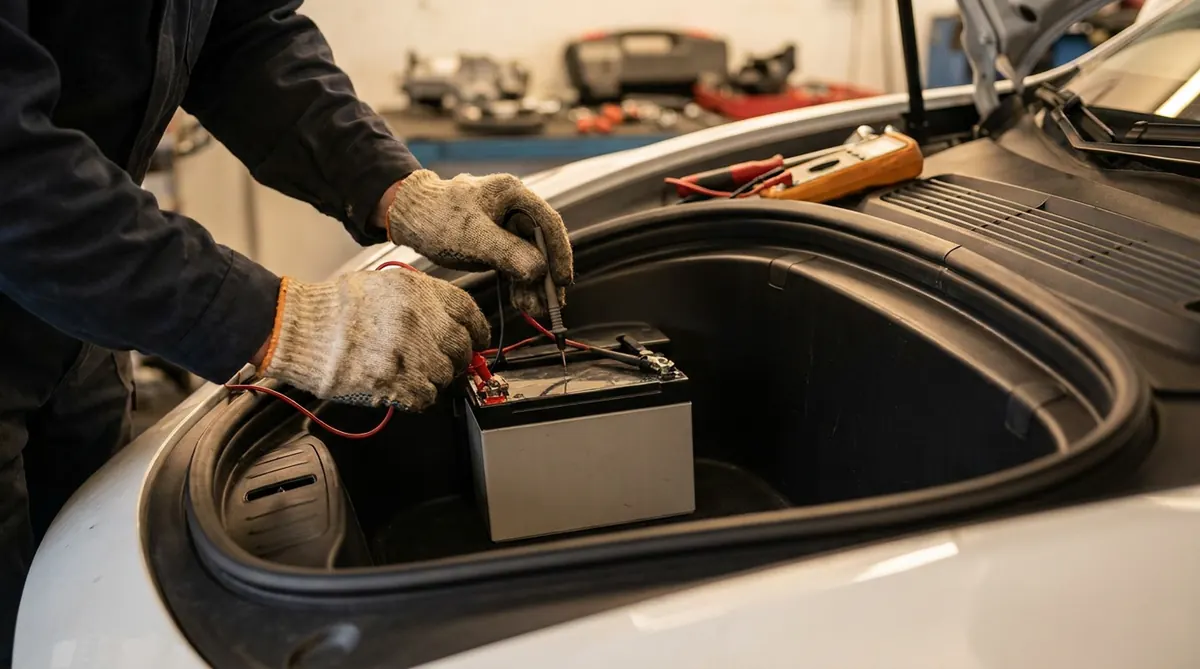
Tesla 12V Battery: Warning Signs It's Failing (and What to Do)
Here's a surprise to a lot of new owners: the thing most likely to strand your Tesla isn't the big battery that drives the car — it's the little low-voltage (12V) battery. It's separate from the main high-voltage pack, and it powers everything you actually touch: the screens, the door handles, the computers, and the contactors that connect the main pack. When it dies, the car can go completely unresponsive even with a "full" charge.
What the 12V battery actually does
Think of it as the car's on switch. Older Teslas use a traditional 12V lead-acid battery; newer Model 3, Model Y, and refreshed Model S/X use a longer-lasting lithium-ion low-voltage battery. Either way, if it can't hold a charge, the car can't "wake up" — and in a bad case you can't even open the doors or the frunk from outside.
Warning signs it's on the way out
- A dashboard or app alert that says something like "12V battery needs service" or "Power reduced." This is your clearest warning — do not ignore it.
- Random electrical glitches — screens rebooting, lights flickering, windows or door handles acting up.
- The car is slow to "wake" from the app, or doesn't respond at all.
- It happens more in cold weather, which is hard on a weak battery.
How long it lasts
A lead-acid 12V in an older Tesla typically lasts around 3–4 years. The newer lithium low-voltage batteries are rated to last much longer. Long periods of sitting unused can drain it faster, since the car still wakes up periodically in the background.
What to do if you get the warning
Treat the "12V battery needs service" alert as a countdown, not a suggestion. You often have a short window — sometimes a day or two — before it fully dies and leaves you locked out. The smart move:
- Don't put it off. Schedule a replacement through Tesla mobile service or a qualified shop right away.
- If it dies completely and you're locked out, Tesla's procedure involves applying external 12V power to access the car. The exact method varies by model, so follow your owner's manual or call Tesla support — don't improvise on a modern car.
- Leave the high-voltage system alone. The 12V battery is a normal serviceable part, but the main pack is lethal — never touch the orange high-voltage cabling.
How to avoid getting stranded
Replace it proactively the moment you get the alert, keep the car plugged in during long storage, and check on it through the app if it's going to sit for weeks. A $100–ish battery replaced on your schedule beats a tow and a ruined morning.
Bottom line: the 12V battery is small, cheap, and the single most common reason a Tesla won't go. Respect the warning light and you'll almost never get caught out.